
dyson ball dc24 instruction manual
Dyson Ball DC24 Instruction Manual: A Comprehensive Guide
This manual details the Dyson Ball DC24’s operation and maintenance. It covers assembly, power controls, attachment usage, and troubleshooting.
Compatibility with V8, V10, V11, and V15 attachments is also discussed, alongside filter and brush bar care.

Understanding Your Dyson Ball DC24
The Dyson Ball DC24 represents a significant advancement in vacuum cleaner technology. Unlike traditional uprights, its Ball™ technology provides enhanced steering and maneuverability, allowing for effortless cleaning around furniture and obstacles. At its core lies the powerful digital motor V9, capable of generating substantial suction for effective dirt removal from various surfaces.
This model is designed for versatility, accepting a range of attachments to tackle diverse cleaning tasks. Understanding the Air Watts (AW) and Kilopascals (kPa) metrics is crucial; AW measures airflow power, while kPa indicates suction strength. The DC24’s performance is optimized through advanced cyclone technology, separating dust and dirt efficiently.
Dyson’s commitment to research and development is evident in the DC24’s design, incorporating noise reduction features for a quieter cleaning experience. The machine’s global presence, with engineering and manufacturing facilities across multiple countries, underscores Dyson’s dedication to innovation and quality. Familiarizing yourself with these core principles will maximize your cleaning efficiency and ensure the longevity of your Dyson Ball DC24.
Unboxing and Component Identification
Upon opening your Dyson Ball DC24 box, carefully verify all components are present. You should find the main body with the dust bin, the wand, the floor head (typically a combination tool initially attached), and a selection of attachments. These commonly include a crevice tool for tight spaces, a mini motorized tool for upholstery and pet hair, and potentially a combination tool offering brush and suction options.
Inspect each part for any shipping damage. The dust bin is located at the base of the machine and slides out for emptying. The wand connects to the main body and attachments, providing extended reach. Note the different connection points – some attachments click directly onto the wand, while others attach to the floor head.
Retain the packaging and documentation, including this instruction manual, for future reference. Familiarize yourself with the location of the power button and any control settings. Ensure you have all necessary parts before proceeding to the assembly stage. A complete inventory ensures a smooth setup and optimal performance from your new Dyson.
Assembly Instructions: Getting Started
Begin by securely attaching the wand to the main body of the Dyson Ball DC24. Align the connection points and push firmly until you hear a distinct click, ensuring a stable connection. Next, select your desired floor head – the combination tool is suitable for most surfaces initially. Attach the floor head to the end of the wand, again listening for a secure click.
For alternative cleaning tasks, choose the appropriate attachment. The crevice tool slides onto the wand for reaching narrow spaces, while the mini motorized tool connects to the wand for upholstery and pet hair removal. Ensure each attachment is firmly locked in place before use.
Before first use, inspect the dust bin to confirm it’s correctly positioned and empty. A properly assembled Dyson DC24 will feel balanced and maneuverable. Double-check all connections to prevent detachment during operation. Refer to the diagrams in this manual if you encounter any difficulties during the assembly process.
Powering On and Off
To power on your Dyson Ball DC24, locate the power button, typically situated on the main body of the machine. Press the button once to initiate the motor. The machine will immediately begin operating at the selected power mode. A visual indicator, such as a light, will confirm the device is active.
To switch off the Dyson DC24, simply press the power button again. The motor will cease operation, and the visual indicator will turn off. Ensure the machine has completely stopped before attempting to detach any attachments or store it away.
Some models may feature a trigger-style power control; squeeze the trigger to activate and release to deactivate. Be mindful of accidental activation, especially when maneuvering the machine. If the Dyson fails to power on, consult the troubleshooting section of this manual for potential solutions, such as checking the battery or power cord.
Selecting Power Modes
The Dyson Ball DC24 offers various power modes to optimize cleaning performance for different surfaces. Typically, a slider or button controls these settings, allowing you to adjust suction power as needed. The ‘Max’ mode delivers the highest suction, ideal for deeply embedded dirt on carpets and rugs. However, using Max mode continuously will reduce runtime on battery-powered models.
A ‘Medium’ or ‘Normal’ setting provides a balance between power and runtime, suitable for general floor cleaning. A ‘Low’ power mode is best for delicate surfaces like curtains or lampshades, minimizing the risk of damage. Some DC24 models may include an ‘Auto’ mode, which intelligently adjusts suction based on floor type detection.
Experiment with different modes to find the optimal setting for each cleaning task. Remember that higher power modes consume more energy, impacting battery life. Regularly check the battery indicator to manage runtime effectively.
Using the Wand and Attachments
The Dyson Ball DC24’s wand extends its reach for cleaning above-floor areas. To attach the wand, locate the release button on the main body and firmly insert the wand until it clicks into place. Detach it using the same button. The wand’s length allows for comfortable cleaning of ceilings, curtains, and furniture.
A variety of attachments enhance the DC24’s versatility. The combination tool features a brush for dusting and a crevice tool for tight spaces. The mini motorized tool excels at removing pet hair and dust from upholstery. Attachments connect to the wand or directly to the main body.
Ensure attachments are securely fastened before use. Regularly inspect them for blockages and clean as needed. Proper attachment selection maximizes cleaning efficiency. Remember that using certain attachments, like the motorized tool, may reduce suction slightly due to increased airflow resistance.
Floor Head Types and Their Uses
The Dyson Ball DC24 typically includes a direct-drive cleaner head designed for various floor types. This head utilizes stiff nylon bristles to agitate carpet fibers and remove embedded dirt. It’s effective on hard floors too, though switching to a softer brush bar is recommended to avoid scratching.
Different floor surfaces require adjusted settings or heads. For delicate hard floors like wood or tile, use the head with the soft brush bar. For carpets, the direct-drive head provides optimal cleaning. The DC24’s ball technology allows for smooth transitions between floor types.
Regularly inspect the brush bar for hair and debris. Tangled hair reduces cleaning performance. Ensure the head is free from obstructions for optimal suction. Compatibility with newer Dyson heads (V8, V10, V11, V15) exists, but voltage differences may affect performance with Slim models. Always prioritize the original head for best results.
Crevice Tool: Reaching Tight Spaces
The crevice tool is a vital attachment for the Dyson Ball DC24, designed for precision cleaning in hard-to-reach areas. This narrow nozzle excels at cleaning along edges, in corners, and between cushions where larger heads cannot fit.

Utilize the crevice tool to target dust and debris in tight spaces like car interiors, along skirting boards, and within furniture crevices. Its focused suction effectively removes dirt from narrow gaps and cracks.

For optimal results, hold the tool close to the surface being cleaned. This maximizes suction power and ensures efficient dirt removal. Regularly check the tool for blockages, as accumulated debris can reduce its effectiveness. The crevice tool’s simple design makes it easy to maintain and ensures consistent performance.
Combine the crevice tool with the wand extension for extended reach. This allows you to clean high or low areas without straining. It’s a versatile tool for detailed cleaning throughout your home or vehicle.
Combination Tool: Versatile Cleaning
The combination tool, included with the Dyson Ball DC24, offers exceptional versatility for a wide range of cleaning tasks. This attachment seamlessly switches between a brush head and a crevice tool, providing adaptable cleaning power.
Utilize the brush head for dusting delicate surfaces like lampshades, bookshelves, and furniture. The soft bristles gently lift dust without causing damage. Rotate the tool to reveal the crevice tool for targeted cleaning in narrow spaces, such as between cushions or along edges.
The combination tool is ideal for cleaning upholstery, curtains, and car interiors. Its adaptable design allows you to tackle various surfaces with ease. Regularly inspect the brush head for tangled hair or debris, ensuring optimal performance.
Combine the tool with the wand extension for increased reach, allowing you to clean high or low areas comfortably. This attachment’s dual functionality makes it a valuable asset for comprehensive cleaning throughout your home.
Mini Motorized Tool: Upholstery and Pet Hair
The Mini Motorized Tool is a powerful attachment specifically designed for deep cleaning upholstery, mattresses, and removing stubborn pet hair from various surfaces. This tool features rotating brush heads that agitate fibers, loosening embedded dirt and allergens.
Effectively eliminate pet dander, dust mites, and hair from sofas, chairs, and car seats. The motorized brush bar provides superior suction and cleaning performance compared to standard attachments. It’s particularly useful for homes with pets, tackling hair that’s difficult to remove with conventional methods.
When using on delicate fabrics, test a small, inconspicuous area first to ensure compatibility. Regularly check the brush bar for tangled hair and debris, removing any obstructions to maintain optimal suction and performance.
Combine the tool with the wand for extended reach, allowing you to clean stairs, upholstery crevices, and hard-to-reach areas with ease. The Mini Motorized Tool is a crucial component for a thorough and hygienic clean.
Emptying the Dust Bin
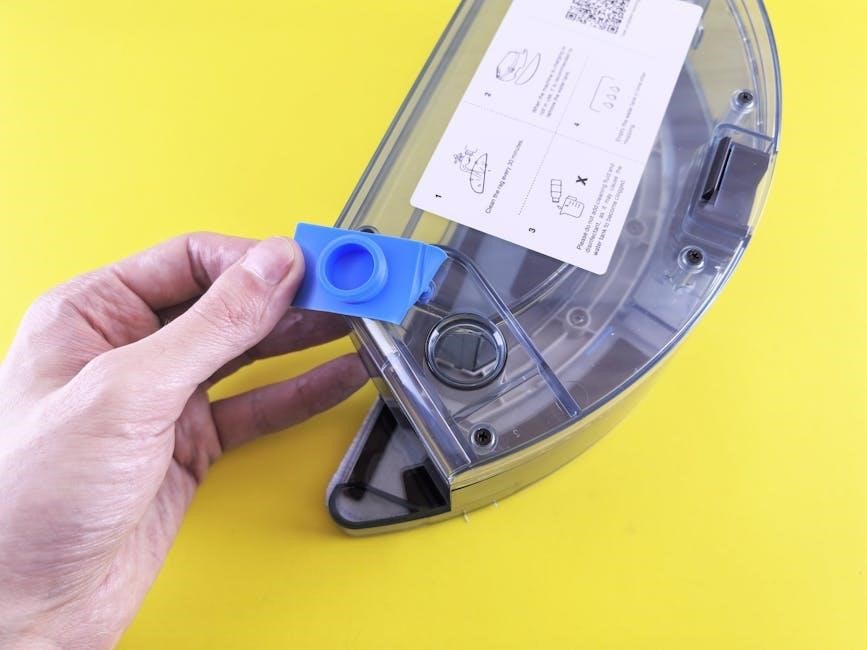
Regularly emptying the dust bin is crucial for maintaining optimal suction power and cleaning performance of your Dyson Ball DC24. A full bin restricts airflow, reducing the machine’s effectiveness. Emptying is a simple process, designed for hygienic disposal of collected dust and debris.
Locate the dust bin release button, typically found on the body of the machine. Press the button to release the bin, and carefully remove it from the cyclone assembly. Hold the bin over a trash receptacle to avoid scattering dust.
Press the bin emptying lever or button (design varies slightly by model) to release the contents. Ensure all debris falls completely out of the bin. If necessary, gently tap the bin to dislodge stubborn particles.
Reinstall the dust bin securely, ensuring it clicks firmly into place. An improperly fitted bin can compromise suction. Avoid washing the dust bin in a dishwasher, as this may damage the plastic. Wipe clean with a damp cloth only.
Filter Maintenance and Replacement
Maintaining clean filters is vital for ensuring consistent suction and air quality from your Dyson Ball DC24. Filters trap fine dust and allergens, preventing them from being exhausted back into the room. Regular maintenance extends filter life and optimizes performance.
Your DC24 typically features a pre-motor filter and potentially a post-motor filter. Locate the filter access point, usually on the machine’s body. Remove the filter(s) carefully, following the instructions in your user manual.
Wash the pre-motor filter regularly (every few weeks, depending on usage) in cold water. Squeeze gently to remove excess water, and allow it to air dry completely – approximately 24-48 hours – before reinstalling. Never use detergents or solvents.
Filters require periodic replacement. The frequency depends on usage and filter type. Check your filter for damage or deterioration. Replace filters when they appear dirty or lose their shape. Using damaged filters reduces suction and can harm the motor.

Brush Bar Maintenance
Regular brush bar maintenance is crucial for maintaining optimal cleaning performance of your Dyson Ball DC24. The brush bar’s bristles collect hair, fibers, and debris, reducing its effectiveness and potentially causing blockages. Consistent care ensures efficient dirt pickup and prolongs the brush bar’s lifespan.
Before any maintenance, ensure the Dyson is switched off and unplugged. Access the brush bar by removing the floor head, following the instructions in your user manual. Carefully remove any tangled hair, threads, or fibers wrapped around the brush bar.
Inspect the brush bar for damage. Check for bent or broken bristles. If significant damage is present, consider replacing the brush bar. A damaged brush bar can scratch floors and reduce cleaning efficiency.
Periodically check the brush bar motor for smooth operation. Ensure it spins freely. If it feels stiff or makes unusual noises, there may be an issue requiring professional attention. Do not attempt to disassemble the brush bar motor yourself.
Troubleshooting Common Issues
Encountering issues with your Dyson Ball DC24 is common, but many are easily resolved. This section addresses frequent problems and provides solutions. If issues persist, consult the full manual or Dyson support.
If the DC24 isn’t turning on, first check the power cord and outlet. Ensure the machine is properly assembled, as sensors prevent operation if components aren’t correctly fitted. Inspect the battery (if applicable) for charge.
Loss of suction often indicates a blockage. Check the wand, hose, and floor head for obstructions. Empty the dust bin – a full bin significantly reduces suction power. Examine and clean the filters as per the maintenance schedule.
A brush bar that isn’t spinning usually signifies a blockage or a motor issue. Disconnect the power and remove any tangled hair or debris from the brush bar. If the motor isn’t functioning, professional repair may be necessary.
Remember to regularly inspect and maintain your Dyson to prevent these common issues.
DC24 Not Turning On
If your Dyson Ball DC24 fails to power on, several factors could be the cause. Systematic troubleshooting is key to identifying and resolving the issue. Begin with the simplest checks before proceeding to more complex diagnostics.
First, verify the power connection. Ensure the power cord is securely plugged into a functioning electrical outlet. Test the outlet with another device to confirm it’s providing power. Inspect the cord for any visible damage, such as cuts or fraying.
Next, check the machine’s assembly. The DC24 incorporates sensors that prevent operation if components aren’t correctly aligned or securely attached. Disassemble and reassemble the wand, hose, and floor head, ensuring a firm click indicates proper connection.
For cordless models, confirm the battery is adequately charged. Connect the charger and allow sufficient time for a full charge. A depleted battery is a common reason for a DC24 failing to start. If the problem persists, the battery itself may require replacement.
Loss of Suction
A noticeable reduction in suction power is a common issue with the Dyson Ball DC24, often indicating a blockage or maintenance need. Addressing this promptly restores optimal cleaning performance.
Begin by thoroughly inspecting the hose and wand for obstructions. Detach these components and visually examine them for any trapped debris, such as large particles or tangled hair. Use a long, flexible tool to dislodge any blockages you find.
Next, check the floor head and attachments; Remove the brush bar and inspect it for hair, fibers, or string wrapped around it; Clear any obstructions to allow the brush bar to rotate freely. Examine the airways within the floor head for blockages as well.
Crucially, empty the dust bin. A full dust bin significantly restricts airflow and reduces suction. Ensure the bin is emptied regularly, ideally after each use. Also, inspect and clean the filters. Clogged filters impede airflow; wash or replace them as needed.
Brush Bar Not Spinning
If the brush bar on your Dyson Ball DC24 isn’t rotating, it indicates a problem requiring immediate attention. A non-spinning brush bar severely limits the vacuum’s ability to effectively clean carpets and floors.
First, power off the vacuum and disconnect it from the power source. Carefully inspect the brush bar for tangled hair, threads, or fibers. These obstructions are the most frequent cause of a stalled brush bar. Remove any debris meticulously.
Check the brush bar motor. Listen for any unusual noises when the vacuum is powered on (after clearing obstructions). A humming sound without rotation suggests a motor issue, potentially requiring professional repair.
Examine the drive belt. If the belt is broken or stretched, the brush bar won’t spin. Replacement is necessary. Also, verify the floor head’s airways are clear. Blockages can prevent the motor from receiving adequate power.
Finally, ensure the floor head is correctly assembled. Improper assembly can interfere with the brush bar’s operation. Refer to the assembly instructions for guidance.
Understanding Air Watts (AW) and KPa
Dyson utilizes Air Watts (AW) to measure suction power, differing from the standard Kilopascals (KPa) often used by other vacuum manufacturers. AW represents a more holistic measure, factoring in both airflow and vacuum (suction) power, providing a better indication of cleaning performance.
KPa measures static pressure – the vacuum’s ability to create suction at the hose opening. However, it doesn’t account for airflow. A high KPa rating doesn’t necessarily translate to superior cleaning if airflow is restricted.
Air Watts consider both airflow (measured in cubic feet per minute – CFM) and water lift (related to KPa). Dyson argues AW provides a more accurate representation of a vacuum’s ability to remove dirt and debris from various surfaces.
The DC24’s AW rating indicates its suction capability. Higher AW values generally signify stronger suction and improved cleaning performance, particularly on carpets. Converting AW to KPa isn’t a direct calculation, as it requires understanding the CFM value as well.
Ultimately, AW offers a more comprehensive metric for comparing Dyson vacuums and understanding their cleaning potential.
Dyson Motor Technology: Digital Motor V9
The Dyson Ball DC24 is powered by a cutting-edge Digital Motor V9, a key component in its powerful performance. This motor represents a significant advancement over traditional electric motors, offering several key benefits.
The V9 is a brushless DC motor, meaning it lacks carbon brushes, resulting in reduced friction and wear. This translates to increased efficiency, reliability, and a longer lifespan compared to brushed motors.
Notably, the V9 motor spins at up to 110,000 revolutions per minute (RPM), generating substantial suction power. Despite its high speed, the V9 is remarkably compact and lightweight – weighing only around 140 grams and measuring 27mm in diameter.
This compact size allows for a more balanced and maneuverable vacuum design. The V9’s digital control system enables precise power management, optimizing performance for different floor types and cleaning tasks.
Dyson’s continuous investment in motor technology, like the V9, is central to its reputation for innovation and superior cleaning capabilities.
Compatibility of Dyson Attachments (V8, V10, V11, V15)

The Dyson Ball DC24 demonstrates impressive compatibility with attachments from other Dyson cordless vacuum models, specifically the V8, V10, V11, and V15 series. This interchangeability offers users flexibility and expands cleaning capabilities.
Generally, floor heads and tools from these models can be physically connected to the DC24 wand and main body without causing damage. However, performance may vary depending on the attachment.
For instance, using a high-torque or laser-equipped head from a V15 on the DC24 might result in faster battery drain due to the head’s higher power demands. The DC24’s motor may not fully support the advanced features of newer heads.
While V10 Slim and V12 Slim attachments are mechanically compatible, voltage differences in the motor systems are a concern. Using a high-voltage V12 Slim head with the DC24 is not recommended.
This broad compatibility allows DC24 owners to leverage newer Dyson technology, enhancing their cleaning experience.
Dyson’s Global Presence and Research
Dyson, the innovator behind the Ball DC24, is a globally recognized technology company with a significant investment in research and development. Founded in 1993, the company has expanded from a small operation in a UK carriage house to a multinational enterprise.
Currently, Dyson maintains engineering, research, development, manufacturing, and testing operations across multiple continents. Key locations include Singapore (global headquarters), the United Kingdom (Malmesbury and Harwell), Malaysia, Mexico, China, and the Philippines.
This widespread presence allows Dyson to tap into diverse talent pools and accelerate innovation. The company’s commitment to research is evident in its continuous development of cutting-edge technologies, such as digital motors and cyclone separation.
Dyson’s focus extends beyond vacuum cleaners, encompassing hair care, air purification, and lighting. The DC24 benefits from this broader research, incorporating advancements in motor technology and airflow dynamics.
The company’s dedication to engineering excellence is a core principle driving the design and performance of products like the Dyson Ball DC24.
Noise Reduction Features
While the Dyson Ball DC24 delivers powerful suction, Dyson engineers incorporated several features to minimize noise during operation. Understanding these aspects can enhance the user experience and address concerns about sound levels.
The digital motor V9, though powerful, is designed for efficient and relatively quiet operation. Its high speed is balanced with acoustic dampening techniques within the motor housing.
Airflow pathways are carefully engineered to reduce turbulence, a major source of noise in vacuum cleaners. Smooth bends and optimized ducting minimize air resistance and associated sounds.
The Ball technology itself contributes to noise reduction by isolating the motor and key components from the main body of the machine. This dampens vibrations and prevents them from resonating.
Furthermore, the design of the floor head and attachments plays a role. Optimized brush bar construction and airflow management contribute to quieter cleaning on various surfaces.
Although not a completely silent machine, the DC24 represents a significant advancement in noise reduction compared to older vacuum cleaner models.
Remote Control and Touch Panel Operation
The Dyson Ball DC24, while a slightly older model, doesn’t natively feature a remote control or touch panel operation like some of Dyson’s newer iterations (V8, V10, V11, V15). Its controls are primarily physical, located directly on the machine.
Power is managed via a simple on/off switch, typically located on the body of the vacuum. Selecting power modes – if available on a specific DC24 variant – is also achieved through physical buttons or a slider.
The DC24 relies on intuitive, tactile controls for ease of use. This approach prioritizes direct interaction and avoids the complexities of digital interfaces.
Users adjust settings directly on the machine, providing immediate feedback and eliminating the need for a separate remote or touch screen.
However, it’s important to note that later Dyson models have embraced remote control functionality and touch panel displays for enhanced convenience and control. These features allow for adjustments from a distance and provide real-time information.
The DC24’s straightforward control scheme remains reliable and user-friendly, focusing on core cleaning functions.